
Lost time on the job rarely starts with a major failure. More often, it shows up in smaller moments—oil dripping at disconnect, hoses that won’t reconnect, or equipment sitting idle while pressure is relieved.
While these delays may seem insignificant, they can quickly add up. The 3FF Series ISO-16028 Connect-Under-Pressure Plugs help reduce those delays by minimizing oil loss and allowing faster reconnections under residual pressure.
Below, we’ll look at how these couplings work and when they’re the right fit for your customers, so you can confidently recommend this time-saving solution.
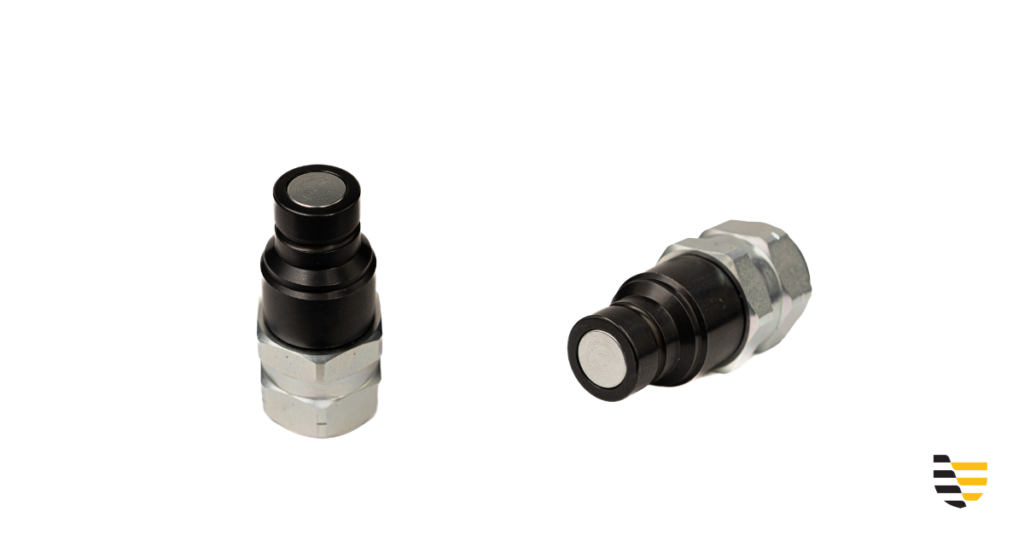
Flat-face hydraulic couplers, often referred to as flush-face couplers, were developed as part of the ISO 16028 family of non-spill hydraulic connections to address a specific problem: oil loss during disconnection.
ISO A, ISO B, and most agricultural couplers use a poppet-style design. These couplers rely on internal poppet valves that open and close during connection and disconnection. While effective for fluid transfer, this design leaves an internal cavity inside the coupler.
When a poppet-style coupler is disconnected, a small amount of hydraulic oil remains trapped in that cavity. Over time, that oil can work its way out and drip onto the ground.
Flat-face couplers address this issue with flat and flush mating surfaces that eliminate the internal pocket where oil and air collect. When disconnected, there is nowhere for oil to pool, greatly reducing or eliminating oil loss at the point of disconnect.

In our 3FF Series, flat-face couplers combine a non-spill, flush-face design with connect-under-pressure capability on the plug side. Together, these features eliminate several common sources of delay that operators encounter during routine connection and disconnection.
Because the flat-face coupling has a flush mating surface, there is no internal cavity for oil to collect when the connection is broken. As a result, disconnecting hydraulic lines does not leave oil dripping onto the ground.
This saves time by eliminating cleanup tasks, surface protection, and the need to manage oil residue before equipment can be moved or stored.
Depending on the job site, oil on the ground can create immediate problems—from cleanup requirements to environmental complaints or fines.
By preventing oil loss at disconnect, this coupling helps operators avoid these issues altogether, reducing interruptions and keeping work moving without regulatory or site-related delays.
Residual pressure in hydraulic lines is a common cause of lost time, especially when equipment heats up during operation and is shut down for short periods. That trapped pressure can make it difficult to quickly reconnect standard couplers.
In our 3FF series, an internal bleed valve in the plug side releases trapped pressure during the connection process. This allows hoses to reconnect without waiting for the system to cool, bleeding pressure manually, or applying excessive force.
When couplers connect cleanly and reliably—without oil mess or pressure-related resistance—operators spend less time diagnosing problems at the connection point.
For distributors, this translates into fewer support calls related to leaks, reconnection issues, or “couplers that won’t connect,” and more confidence that the product will perform as expected.
By addressing oil loss and trapped pressure at the connection point, the 3FF Series ISO-16028 Connect-Under-Pressure Plugs reduces interruptions that slow customers down.

Not every hydraulic application requires the same coupling design. Understanding where and how equipment is used is the fastest way to determine whether a traditional poppet-style coupler or a flat-face design with connect-under-pressure plugs is the better fit.
In open environments such as agricultural fields, small amounts of oil loss at disconnect are typically acceptable. For these applications, the simplicity of ISO-A, ISO-B, and other poppet-style couplers often makes them a practical, cost-effective choice.
The 3FF Series is better suited for applications where cleanliness, surface protection, and environmental expectations are higher. This includes construction equipment, rental fleets, and machines that operate on paved surfaces or residential properties.
In these environments, oil dripping onto driveways, sidewalks, or job sites is far more noticeable—and usually far less acceptable, making flat face couplers a stronger option.
Connect-under-pressure plugs are most effective when used in the right pressure scenario. They’re designed to address moderate residual pressure—the type that builds naturally in hydraulic lines due to heat and short shutdown periods during normal operation.
However, connect-under-pressure is not intended for every pressure scenario. For instance, in applications operating at extreme pressures, screw-to-connect or heavy-duty couplers should be used instead. These designs intentionally slow the connection process to provide additional safety and prevent accidental disconnection under dangerous pressure levels
In the end, saving customers hours isn’t about changing how they work; it’s about removing the friction that slows them down. Oil cleanup, stalled reconnections, and pressure-related delays all cost time when they show up repeatedly in daily operation.
When an application calls for it, PCI’s 3FF Series ISO-16028 Connect-Under-Pressure Plugs give you a proven option to help customers save time and stay productive. We’re built to be the distributor’s distributor, helping you fill inventory gaps and deliver reliable solutions your customers depend on.
Request a quote to get pricing, availability, and support tailored to your customer’s needs.
