
Selecting the right hydraulic gauges directly impacts your customers’ uptime, safety, and equipment performance. As a distributor, your guidance helps end users avoid costly failures by ensuring they use the right type of pressure gauge for their application.
Both analog and digital hydraulic gauges play an important role in the field. The challenge is knowing when a customer simply needs a dependable option and when their system or industry requires greater precision.
This guide breaks down the differences between analog vs. digital gauges, the applications each one serves best, and the key questions to ask so you can confidently recommend the right tool every time.

Hydraulic systems depend on reliable, consistent pressure. When a gauge isn’t reading correctly, customers risk downtime, equipment damage, and potential warranty disputes. Even small inaccuracies can turn into costly failures.
Your customers rely on you to help prevent those problems.
By understanding the differences between analogue and digital gauges, you can guide customers to the best option for their specific application.
Each hydraulic gauge serves a different level of accuracy and functionality. Let’s look at the differences.
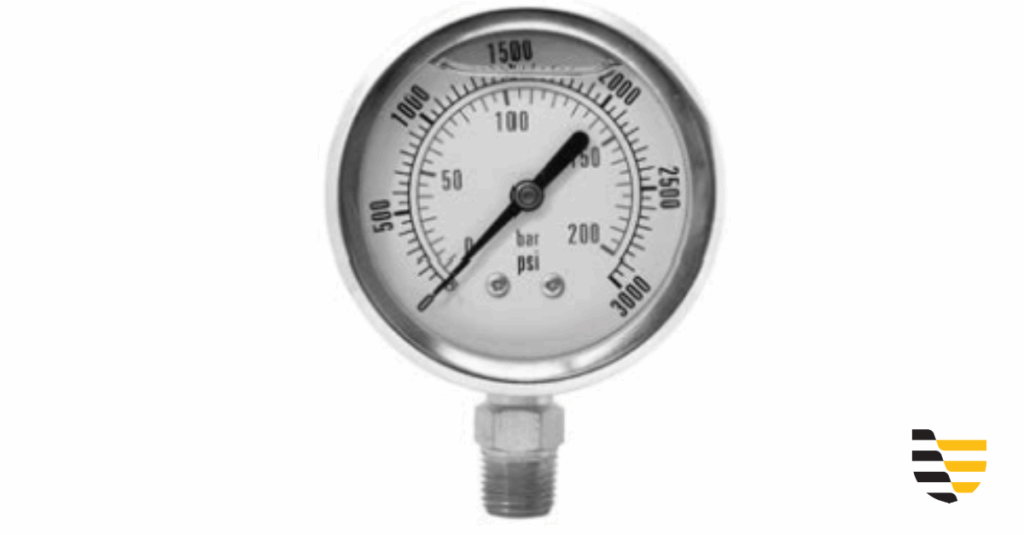
An analog pressure gauge is a mechanical, needle-style gauge that requires no power, batteries, or programming. Many analog gauges are glycerine-filled to help stabilize the needle and improve readability in high-vibration environments.
An analog pressure gauge is a common, familiar choice for general-purpose hydraulic applications. They’re lower cost, require no batteries or programming, and are extremely straightforward to install. Simply screw it on, and it works.
For most customers, an analog gauge is the right choice when they only need an approximate reading—around 2,000 PSI, for instance—rather than an exact value.
They’re ideal for general-purpose pumps, hydraulic lines, and routine checks where simplicity, familiarity, and affordability matter more than exact numerical precision.
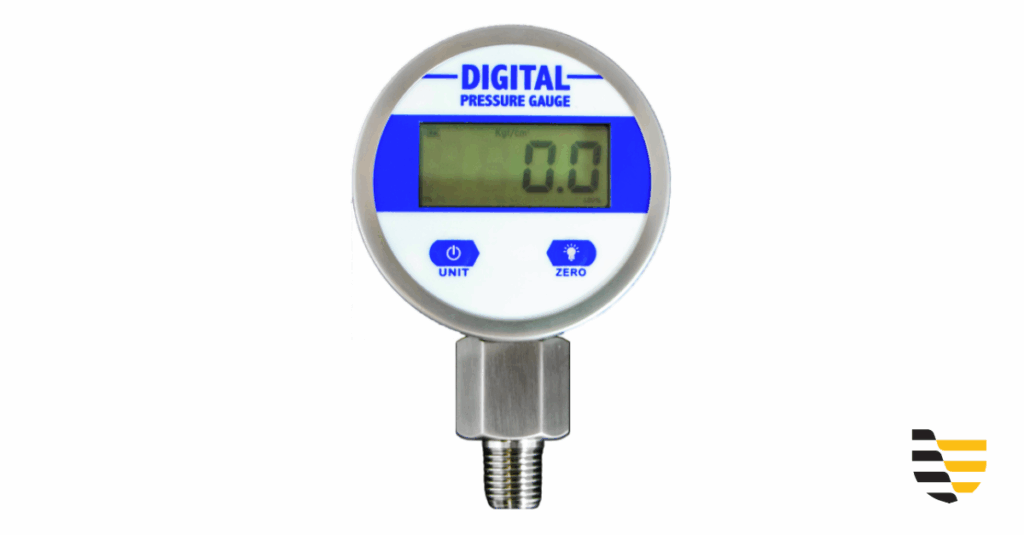
A digital hydraulic gauge displays exact numerical readings, often down to two or three decimal places.
Digital gauges range from simple readout models to advanced “master digital” versions that can log data, track performance over time, and interface with computers or controllers when customers need documentation or reporting.
A digital pressure gauge is the better choice when customers need exact readings and tight control over system limits. Their displays make it possible to monitor specific thresholds, such as ensuring a system cannot exceed 2,000 PSI.
This level of accuracy is especially valuable on high-cost pumps, cylinders, and other equipment where small overpressure events can cause serious damage. But their higher precision does come at a higher price point.
Digital gauges may also be a requirement for municipalities or regulated industries that must track and document performance across their equipment fleets. And because they show exact numerical values, they provide clearer documentation for service records and warranty claims.
Even though digital gauges offer modern precision, they’re not a universal replacement for analog gauges. Many technicians still rely on analog for quick, at-a-glance readings, especially when monitoring multiple gauges at once or watching how pressure changes over time.
The needle’s natural damping makes it easier to see trends and movement, while digital displays require more intentional focus. On the other hand, digital gauges shine when exact values matter, and when customers need data they can record or reference later.
That’s why it’s important to carry both, not because one is universally better, but because each solves a different type of problem. The key is recommending the one that fits the customer’s specific application.

A few quick questions will tell you whether an analog or digital gauge is the better fit and prevent under- or over-specifying the solution.
Does the customer need a general reading or precise, decimal-level data? A quick way to gauge this is to ask whether they need to know pressure exactly or just verify that it’s “in the right range.”
Understanding the risk, from minor inconvenience to major equipment damage, helps determine how exact the gauge needs to be. If even small pressure deviations create performance or safety issues, digital accuracy becomes more important.
If their industry or application has reporting requirements, then digital is necessary. Standard digital gauges provide precise readings, while “master digital” models add data logging and computer interface capabilities for customers who need detailed records.
Analog offers simplicity and lower cost; digital offers precision and may require recalibration over time in high-impulse applications. For customers with tight timelines or limited technical support, the simplicity of analog may outweigh the added capabilities of digital.
Whether your customer needs a straightforward, reliable analog gauge or a precise, data-ready digital model, PCI gives you options you can trust.
The PCLG Series offers durable, glycerine-filled, stainless-case analog gauges that are easy to install, easy to read, and built for everyday hydraulic applications. For customers who need exact numerical accuracy, the PCDG Series provides digital gauges with clear LCD readouts, backlighting, multi-unit capability, and 0.25% full-scale accuracy.
At PCI, every order you place is treated with urgency, accuracy, and respect because we understand how it reflects on your customer relationships. When you need dependable components and a partner who makes your job easier, we’re here to support you with fast service and reliable availability.
View our full product catalog and request a quote today to get started.
